Why The Missing Link To Your Running Training Is Not More Running
It should come as no surprise that strength training is crucial for runners. Especially those who want to perform to the best of their ability, develop a resilient body that can stand the test of time, and avoid those frustrating overuse niggles during race prep.
That rings true for all runners, but if we shift focus towards ultra running, I would stand by these comments even more so. To the point where I personally believe for longer, more mountainous events, being strong will more often than not pay more dividends than a high VO2 max or lactate threshold ever will.
“But are’t all the best runners in the world super small with no muscle” I hear you ask?? And yes, you would be correct. But to this I would answer twofold. Firstly, most of us are not the best runners in the world. And secondly, I would be fairly confident in saying you are probably underestimating their capacity and level of strength. Strong does not have to mean ‘big’ and lots of muscle mass.
So keeping this in mind, we can immediately drop the idea that going to the gym in aim of getting strong will make you gain loads of muscle/weight and in turn slow you down as a runner. Instead, we know that if you go to the gym and complete quality/intentional strength work, you will gain strength, improve resilience, and in turn be able to run faster and further.
MBP Strength Benchmarks For Runners
‘Strong’ is quite a broad term, and will look a little different for all athletes. This is why it is helpful to have data to work from. Benchmarks give a really clear way to track your progress; to see what areas are strong already, which need more work and attention, and to help you develop a frame that is strong in all the right places.
Here at MBP we have refined a simple yet extremely effective benchmark system that all of our 1-1 athletes will be tested against when they commence coaching. This gives us clear, real-time data on where they are at right now, and what needs work to ensure they hit and surpass their goals.
Below you will find some of the key benchmarks;
Single Leg Press
1.5 x BW for 6-8 reps on each leg
Straight Leg Single Leg Calf Raise
Loaded: 1 x BW for 6+ reps on each leg
Unloaded: 30+ quality reps [1s up / 1s down] on each leg
Bent Knee Single Leg Calf Raise
1.5 x BW for 6+ reps on each leg
Single Leg Knee Extension
0.5-0.8 x BW for 5 reps on each leg
Single Leg Knee Flexion
0.5-0.8 x BW for 5 reps on each leg
Single Leg Hamstring Bridge
25+ quality reps [1s up / 1s down] on each leg
Single Leg Box Squat
30+ quality reps [1s up / 1s down] on each leg
Adductor Long Lever Side Plank
40s+ quality hold on each leg
Abductor Long Lever Side Plank
40s+ quality hold on each leg
The above list of benchmarks can be applied to all levels of athlete due to most, if not all, being relatively low skill and set up in a way that allows for a safe and high expression of force.
How To Implement Strength Work
Just like you would with your running, chasing certain times over different distances, having overarching goals with your strength work is only going to be beneficial.
Perhaps the more tricky part comes with actually implementing a strategy that allows you to work towards these markers without cooking your legs and completely ruining your running. No one wants to head out for their long run or hard interval session with legs that feel detached from their body following a super intense leg day in the gym. That is one of the key reasons why here at MBP we programme strength work in a way that complements your running sessions - allowing you to still feel good and perform on running days, but also gain strength and bulletproof your body in the gym.
It is a whole topic in and of itself that I could write a small book on, so I will keep this top line and simple. Throughout any given year or season your running load should ebb and flow. As you build towards a race, volume and intensity will gradually build, getting you and your body prepped for a big performance. Post race you will take time out, where running load will be lower to allow for optional recovery. From here, you may then go into a maintenance or base building period where volume/load stays more consistent.
Now, if we take the same thought process and flip to strength work, it becomes quite clear where, when, and how long we can push things for. If we are building running volume and intensity for a race, perhaps the best idea would be to keep strength volume/intensity consistent, and even gradually decrease in line with the running build. Similarly, post race when run volume is lowest, this could be a great opportunity for you to increase intensity and volume in the gym ahead of your next build.
We could also plot this on a graph. Imagine a Spring Marathon [London in April], followed by a summer of strength focused/biased work whilst running a base building phase on feet, before another marathon in the Autumn [Valencia in December].
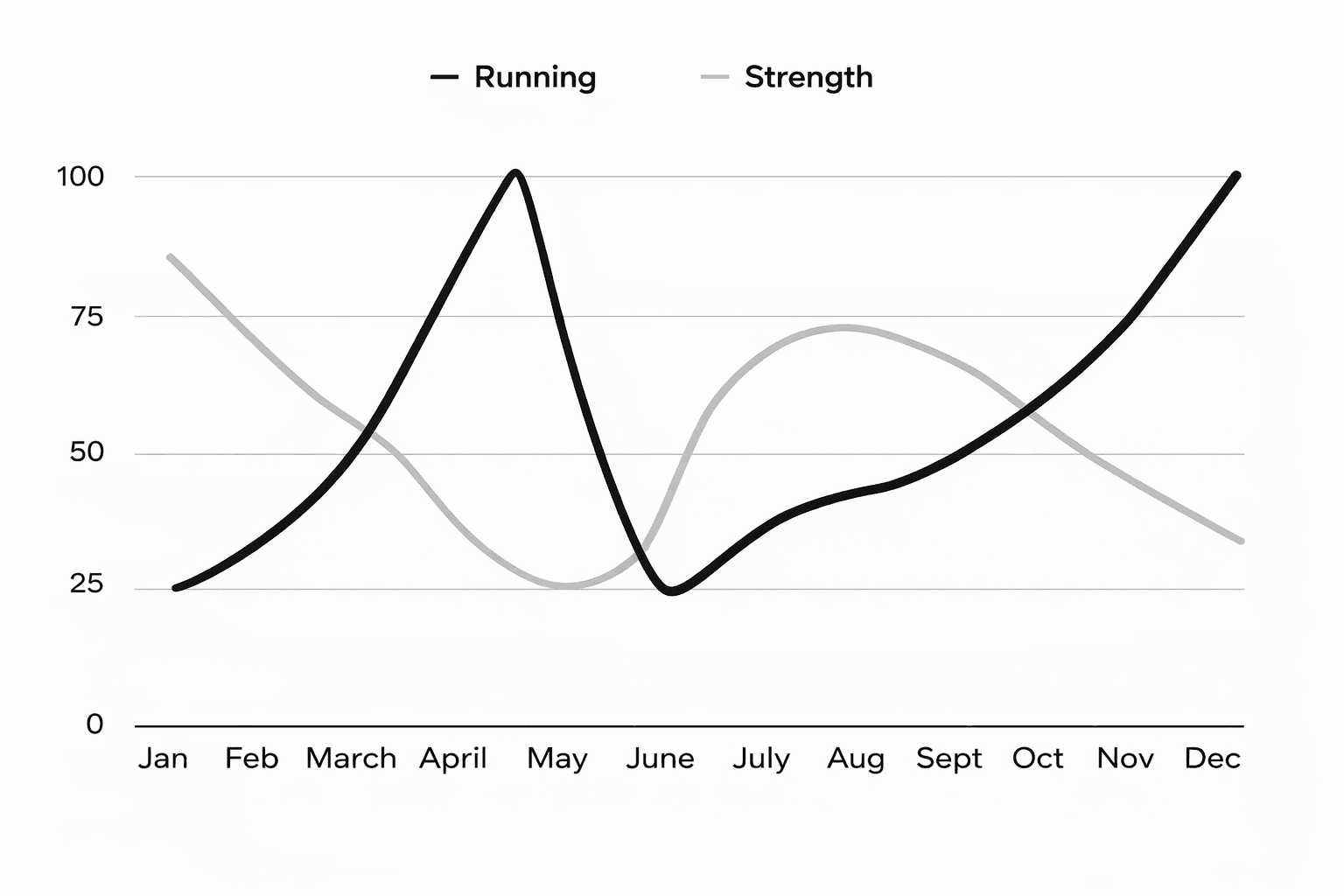
As you can see, both your running and strength work can be considered, and a well balanced approach can be achieved. It just takes some intentional planning and understanding that going 110% in all areas of training, all the time, is not the way.
Measuring Progress the Right Way
The scale doesn’t define you — consistency does.
We noticed early on that many people quit because they weren’t seeing fast visual changes. So we redefined what progress looks like.
Instead of just focusing on weight or measurements, we introduced a multi-metric approach:
Energy consistency
Training frequency
Sleep quality
Recovery efficiency
By shifting attention away from superficial results, people started to see fitness as something they live, not something they chase.
And the results spoke for themselves — stronger bodies, sharper minds, and higher self-esteem.