Plyometrics: What, Why, How & When
Runners are often told by physios, strength coaches and high level athletes that if plyometrics are not a part of their weekly training schedule, then they are shooting themselves in the foot and missing out on potential performance. But of course, there are levels and nuances to consider when adding them into your own training.
Why, when and how you do them will all impact what they give you in return. Be that an overall increase in running economy, increased bone strength, better tendon stiffness, better ground contact control or a combination of all. Different types of plyometrics will target each of these areas in different ways.
Two of the most common / easiest ways to differentiate plyometrics are by ground contact time [GCT] and joint angle.
Light tier plyometrics are defined by having short GCT and small joint angles, being more stiff, bouncy and intense in nature. Alternatively, deep tier plyometrics have a longer GCT and bigger joint angles, with a softer, more supple execution. In the middle of the two we have medium tier plyometrics, which as you can maybe guess, have a GCT and joint angle that sits between the two. Ping tier plyometrics are the most intense and have the shortest ground contact time, focussing on rapid force production and maximum power development.
Each tier has a different focus, and is used to drive a different stimulus and in turn, different adaptation. But at their core, they all teach your body to store and use elastic energy. Improving how efficiently you can run, how resistant you are to injury and how far you can go without breaking down. Generally speaking as we move through the tiers [from light to ping], not only does the demand and recovery cost increase, but so does the skill demand. So for those reading this who have not done much plyometric work, or are new to the training style, I would recommend you focussing more on the basics of the light tier before moving onto more medium and deep tier work - and finally ping tier.
Below I will outline the key factors of each tier.
Light Tier
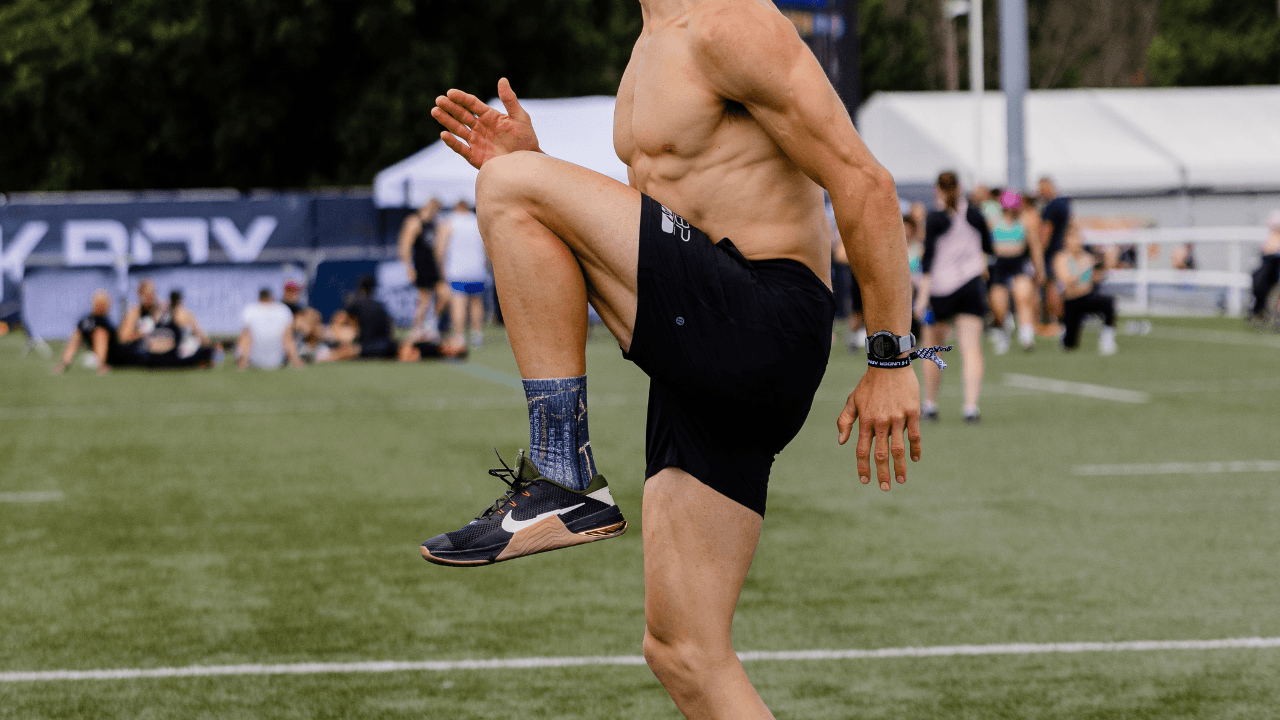
These are lower impact and high frequency with short and fast ground contact times. Stiffness and rhythm are key in quality execution and they are often referred to as ‘hops’.
Key Characteristics;
Intensity: Lower intensity due to minimal eccentric loading and lower ground reaction forces
Volume: Suitable to be performed in bigger sets [15-20reps]
Focus: Ankle stiffness, rhythm development, timing, ground force production
Purpose: Activation, skill development, neural prep, foundational stiffness/tendon strength
Examples;
Pogo Jumps [dual or single leg]
A-Skips
Plate Hops
Travelling Zig Zag Pogo
Medium Tier
Medium tier plyometrics, more often known as leaps or bounds are executed with longer ground contact times than light tier, with larger joint angles and more of a power focus.
Key Characteristics;
Intensity: Moderate [but sub maximal] intensity due to higher eccentric loading
Volume: Moderate volume. Lower than light but higher than maximal effort work [10-40m]
Focus: Requires a natural and relaxed execution despite high force. Aiming to move with quality
Purpose: Develop rhythm and ability to connect elastic qualities with absolute strength
Examples;
Broad Jumps
Skater/Lateral Bounds
Travelling Leap
Vertical Jumps
Deep Tier
Deep tier plyometrics focus on force absorption more than production, with big joint angles, long ground contact times and much more muscular involvement compared to the other tiers.
Key Characteristics;
Intensity: Low intensity but high energy demand/cost due to lack of elasticity
Volume: Lower volume due to recovery cost and strength element
Focus: Softness, rhythm and timing whilst staying ‘active’ throughout
Purpose: Develop force absorption, eccentric strength and joint stability
Examples;
Split Squat Jumps
Squat Jumps
Lateral Deep Tier Jumps
Ping Tier
Ping tier are the most ‘spicy’ of all. High intensity, high ground forces with the lowest GCT and very stiff joints.
Key Characteristics;
Intensity: The highest intensity of all plyometrics due to the highest ground reaction forces
Volume: Low volume due to high intensity
Focus: Hitting the ground hard with maximal force and stiffness through the lower body
Purpose: Develop elastic strength, high tendon stiffness and rate of force development
Examples;
Pogo Jumps
Straight Leg Bounding
Drop Jump Pogo
Quite a lot right? Maybe more than you realised.. But as with many forms of training, doing something is far better than doing nothing.
So no, most ‘gen pop’ clients/athletes maybe don’t need a multi layered, varied tier approach to their plyometric training. But yes, they should absolutely be doing it to some extent. However, more experienced, higher level athletes will likely benefit from a more detailed and specific approach with all tiers involved in their training program.
The most benefits come from plyometrics that are executed with high quality. Which is why doing the basic light tier work really well is key before moving onto the more demanding tiers. So when should plyometrics should be done? This will depend on an athletes personal training schedule, where they are in their training block and their overarching goals. But a general implementation across a race block could look like;
START OF BLOCK
|
Light tier
Start the block by building quality fundamentals, developing more skill, rhythm and timing
|
Deep tier
As you progress through the start of the block and skills develop, bring in deep tier work to build more control and increase bone loading
|
Medium tier [more intensity + stimulus]
More intense in execution but with less recovery cost due to less muscular demand means a solid stimulus around higher run volume later in the block
|
Ping tier [low volume, higher skill, less cost]
The stiffest and most powerful in execution, but in small doses allow for great stimulus around highest run volume, without the high recovery cost
|
END OF BLOCK
As mentioned above, the most optimal integration of plyometrics will likely look slightly different from athlete to athlete.
But this framework is a strong place to start for most.
Coach Ben